
Digital Marketing: A Practical Guide to Growing Your Business Online
1. Introduction
Are you struggling to attract customers, generate leads, or make your business visible online? Digital marketing helps you connect with the right audience through search engines, social media, email, websites, and paid advertising.
Whether you run a small shop in Ahmedabad, manage an online store in Mumbai, or operate a growing company in Bengaluru, the right online marketing strategy can help you reach potential customers where they spend their time. However, choosing the right channels and managing your budget can feel confusing when you are just starting.
This guide explains how digital marketing works, which services matter most, how to choose the right strategy, and how to measure progress. You will also learn practical steps to improve your online presence and make informed marketing decisions.
2. Main Body
What Is Digital Marketing and Why Does Your Business Need It?
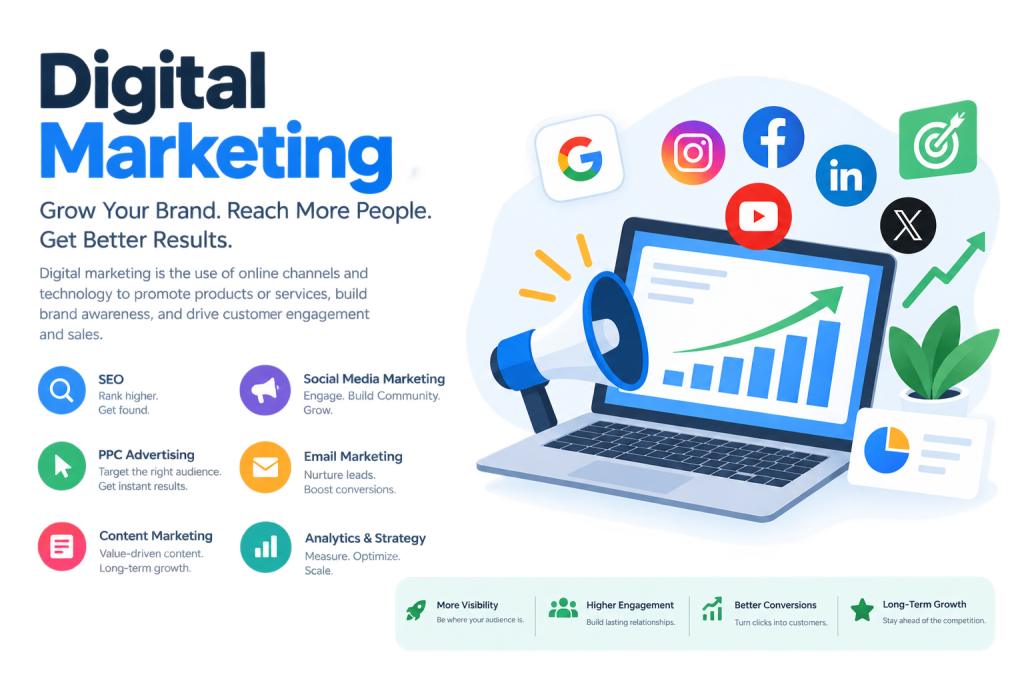
Digital marketing is the process of promoting products, services, and brands through digital channels. It includes search engine optimisation (SEO), social media marketing, online advertising, email campaigns, content marketing, and other methods that help businesses connect with potential customers.
Unlike traditional advertising, many digital channels allow you to track actions such as website visits, enquiries, purchases, and campaign costs. This makes it easier to understand which activities are helping your business and where you may need to improve.
Key benefits of online marketing
A well-planned marketing strategy can help your business:
Reach relevant customers: Target people based on their interests, location, search behaviour, or needs.
Build brand awareness: Help more people discover your business through search engines and social platforms.
Generate enquiries: Encourage visitors to call, submit a form, or contact your team on WhatsApp.
Measure performance: Use analytics to understand traffic, conversions, and campaign spending.
Compete locally: Help customers find your products or services when searching for businesses in their area.
For example, a clothing store in Ahmedabad could publish useful product guides, optimise its Google Business Profile, and run targeted social media campaigns before the Diwali shopping season. Each activity supports a different stage of the customer’s journey.
The key is to choose channels that match your audience, budget, and business objectives rather than trying every marketing method at once.
Which Digital Marketing Services Should You Use?
The right combination of digital marketing services depends on your goals. A business seeking long-term organic traffic may prioritise SEO, while a new ecommerce store might use paid advertising to test product demand.
1. Search engine optimisation (SEO)
SEO helps improve your website’s visibility in organic search results. It includes keyword research, helpful content, technical improvements, internal linking, and earning relevant backlinks.
For example, an interior design studio could create pages targeting searches such as “interior designer in Ahmedabad” and publish guides about home renovation costs.
SEO can support long-term visibility, but results are not immediate or guaranteed.
2. Social media marketing
Social media marketing helps you connect with audiences on platforms such as Instagram, Facebook, LinkedIn, and YouTube.
Businesses can share product demonstrations, educational posts, customer stories, and short videos. Consistent publishing and meaningful engagement help build familiarity with your brand.
3. Pay-per-click advertising (PPC)
PPC advertising allows businesses to pay for clicks or other defined advertising outcomes, depending on the platform and campaign type. Google Ads can help reach people searching for particular products or services.
A PPC agency may assist with keyword selection, campaign setup, audience targeting, landing pages, and performance tracking. Paid campaigns can generate traffic quickly, but costs may rise when targeting is broad or conversion rates are low.
4. Email marketing
Email marketing helps businesses communicate with subscribers through newsletters, promotional campaigns, product updates, and automated messages.
An ecommerce business, for instance, can send a reminder to shoppers who leave products in their carts. Always follow applicable privacy requirements and provide an appropriate unsubscribe option.
5. Content marketing and online advertising
Content marketing uses helpful articles, videos, guides, and other resources to answer customer questions. Online advertising promotes your business through paid placements across search engines, social platforms, websites, and other channels.
These approaches work well together: useful content builds understanding, while relevant advertising can help more potential customers discover it.
Digital marketing channel comparison
Channel | Best suited for | Main consideration |
|---|---|---|
SEO | Long-term organic visibility | Requires consistent effort |
Social media | Engagement and brand awareness | Needs relevant, regular content |
PPC advertising | Targeted traffic and lead generation | Requires budget management |
Email marketing | Retention and repeat purchases | Needs a relevant subscriber list |
Content marketing | Education and trust | Content should answer real questions |
How to Create a Digital Marketing Strategy Step by Step
A clear digital marketing strategy connects your business goals with the channels, content, and measurements needed to achieve them.
Follow this practical six-step process.
Step 1: Define your business goals
Start with a specific objective. You might want to increase qualified enquiries, improve online sales, grow local awareness, or encourage repeat purchases.
Avoid vague goals such as “get more traffic” without considering what that traffic should achieve.
Step 2: Understand your target audience
Identify who your customers are, what problems they face, and how they search for solutions.
For an Indian small business, useful questions include:
Do customers prefer calling, visiting a shop, or ordering online?
Which languages do they use when searching?
Are they comparing prices or looking for specialist expertise?
Which cities or service areas should you target?
These answers help you create more relevant campaigns.
Step 3: Research keywords and competitors
Use tools such as Google Keyword Planner, Google Trends, and Google Search Console to understand search demand and website performance.
Group keywords by intent. For example, “what is digital marketing” is mainly informational, while “digital marketing agency near me” suggests that someone may be looking for a provider.
Review competitor websites to identify useful content topics, service gaps, and ways to communicate your value more clearly.
Step 4: Choose your marketing channels
Select two or three channels that align with your goals and resources. A local service provider might begin with local SEO and Google Ads, while a fashion brand might prioritise Instagram, ecommerce SEO, and email marketing.
You can expand your channel mix once you have enough performance data to make informed decisions.
Step 5: Create and optimise your campaigns
Build helpful landing pages, write clear calls to action, and ensure your website works well on mobile devices.
For paid campaigns, use relevant keywords and landing pages. For SEO, organise content around customer questions and link related pages together. For social media, develop a realistic publishing schedule.
Step 6: Measure and improve performance
Track a small set of meaningful metrics rather than focusing on every available number.
Useful metrics include:
Organic clicks and search impressions
Cost per lead
Conversion rate
Customer acquisition cost
Return on advertising spend
Repeat purchases and email engagement
As a simple example, if you spend ₹10,000 on a campaign and generate 20 qualified enquiries, your cost per enquiry is ₹500. This is an illustrative calculation, not a benchmark for every industry.
Review performance regularly and use the results to improve targeting, messaging, and budget allocation.
How to Choose a Digital Marketing Agency in India
If you do not have an in-house marketing team, working with a digital marketing company may help you access specialist skills and manage campaigns more efficiently.
However, agencies differ in experience, pricing, reporting practices, and service quality. Compare providers carefully before committing.
What should you check before hiring?
Relevant experience: Ask whether the agency has worked with businesses similar to yours.
Clear deliverables: Understand exactly what SEO, content, advertising, or reporting services are included.
Transparent pricing: Request a breakdown of management fees, advertising spend, and additional costs.
Performance reporting: Check how often you will receive reports and which metrics will be tracked.
Account ownership: Ensure you retain appropriate access to your website, analytics, advertising accounts, and business listings.
Realistic expectations: Be cautious of guaranteed rankings, guaranteed leads, or claims of instant results.
If you search for a “marketing agency near me” or “digital marketing near me”, review local expertise alongside the provider’s communication, processes, and fit with your business.
Should you hire an agency or manage marketing yourself?
Factor | In-house or DIY | Digital marketing agency |
|---|---|---|
Cost structure | Staff time and tool expenses | Agency fees plus applicable campaign costs |
Control | Direct day-to-day control | Shared planning and execution |
Expertise | Depends on your team’s skills | Access to a range of specialists |
Flexibility | Can be adjusted internally | Depends on the contract and scope |
Neither option is automatically better. If your needs are simple and you have time to learn, managing a few channels yourself may be practical. If your campaigns require multiple specialists or more complex reporting, an agency may be worth considering.
Digital Marketing Tips for Indian Small Businesses
Small businesses often have limited budgets, so the goal should be to prioritise activities that support real business outcomes.
Focus on local visibility
Keep your Google Business Profile accurate, including your business hours, contact details, services, and location where applicable. Encourage genuine customer reviews and respond professionally to feedback.
Create useful location-specific website content where it serves a real customer need. Avoid making multiple near-identical city pages just to target keywords.
Plan campaigns around customer demand
Indian businesses can plan relevant promotions around Diwali, Navratri, Eid, regional festivals, seasonal shopping, and other occasions important to their audience.
Prepare landing pages, inventory, creatives, and tracking before launching a promotion. A discount alone will not guarantee profitable sales.
Keep your website mobile-friendly
Check loading speed, readability, navigation, contact forms, and checkout on mobile devices. Make it easy for visitors to find prices, understand your offer, and contact your business.
Avoid these common mistakes
Spending on ads before defining a conversion goal.
Targeting too many unrelated keywords.
Publishing content without understanding search intent.
Ignoring website analytics and lead quality.
Buying backlinks or using manipulative SEO tactics.
Expecting immediate organic rankings.
Increasing advertising budgets without checking profitability.
The best approach is to start with a clear objective, establish a baseline, test improvements, and invest more when the evidence supports it.
3. Frequently Asked Questions
1. What is digital marketing in simple words?
Digital marketing means promoting your business online using channels such as Google Search, social media, email, websites, and paid advertisements. It helps you reach potential customers, explain your products or services, and encourage actions such as enquiries, purchases, or bookings.
2. How much does digital marketing cost in India?
The cost depends on your business goals, competition, channels, and the work required. A campaign may involve agency fees, content production, software, and advertising spend. Request an itemised quotation and compare expected deliverables before deciding how much to invest.
3. Which digital marketing strategy is best for a small business?
The best strategy depends on how customers find and choose your products or services. Local businesses may benefit from local SEO and a Google Business Profile, while ecommerce brands may combine SEO, social media advertising, and email marketing. Start with clear goals and measure results.
4. How long does digital marketing take to show results?
Paid advertising can begin generating visits soon after a campaign launches, although profitable conversions are not guaranteed. SEO usually requires sustained work and may take several months to show meaningful progress. Timing varies with competition, website quality, budget, and the effectiveness of your strategy.
4. Conclusion
Digital marketing gives businesses practical ways to improve online visibility, reach relevant audiences, and build stronger customer relationships. From SEO and social media to PPC advertising and email campaigns, each channel serves a different purpose.
The most effective approach starts with understanding your audience, setting measurable goals, and choosing channels that fit your resources. Track meaningful results, improve your campaigns regularly, and avoid spending money on activities without a clear objective. Whether you manage marketing yourself or partner with an agency, a consistent, customer-focused strategy can help your business build a stronger online presence.
5. Call to Action
Ready to strengthen your online presence and reach more potential customers?
Explore the right digital marketing strategy for your business and identify the services that match your goals and budget.
Contact our team to discuss your digital marketing requirements and plan your next steps.
6. SEO Notes
Primary keyword: Digital Marketing
Primary keyword placement: SEO title, meta description, H1, introduction, and relevant body content.
LSI keywords used: digital marketing agency, online marketing, digital marketing company, online advertising, marketing strategy, Google digital marketing, digital marketing services, digital advertising, marketing agency near me, internet marketing, PPC agency, digital marketing near me, digital marketing strategy, digital marketing agency near me.
Keyword to review: “gudangbasi com digital marketing” was excluded because its relevance to the topic is unclear. Use it only if it relates to a genuine subject or brand covered by your page.
Estimated word count: Approximately 1,900 words for the full page, depending on how headings, tables, and metadata are counted.